
Watching Someone Else’s Recovery, In Real Time
One Mid Mama’s journey has my attention
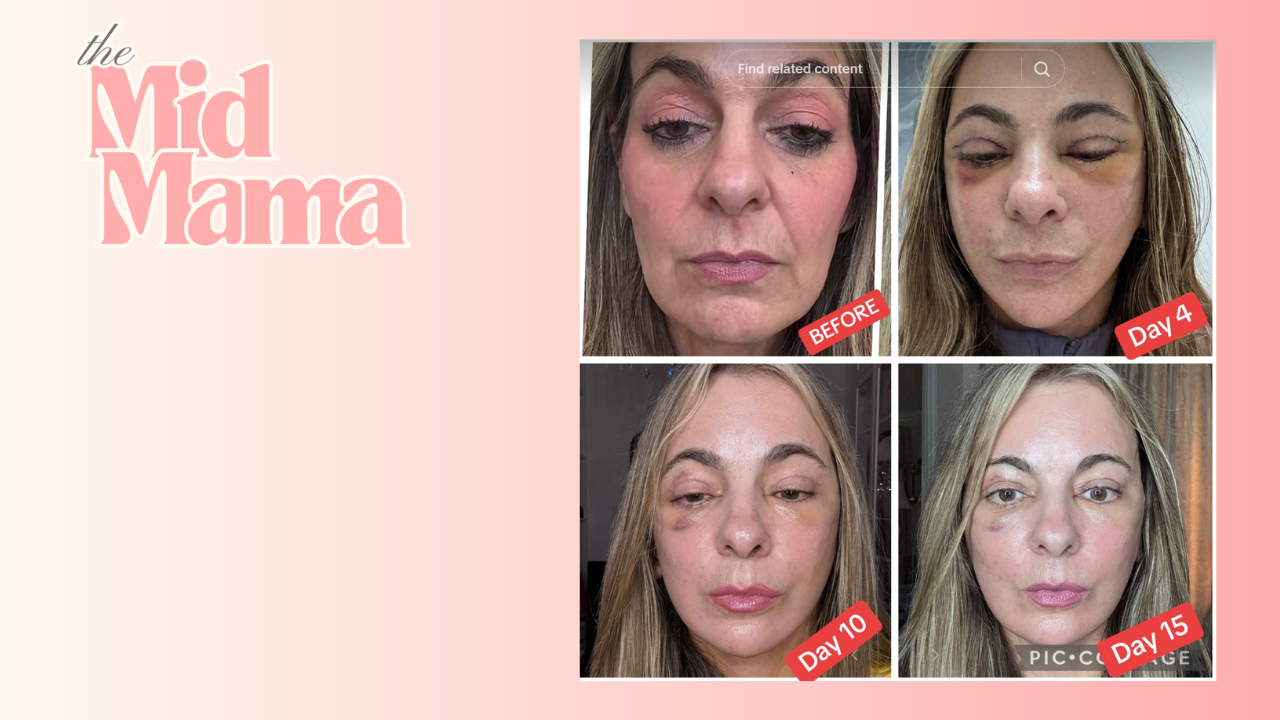
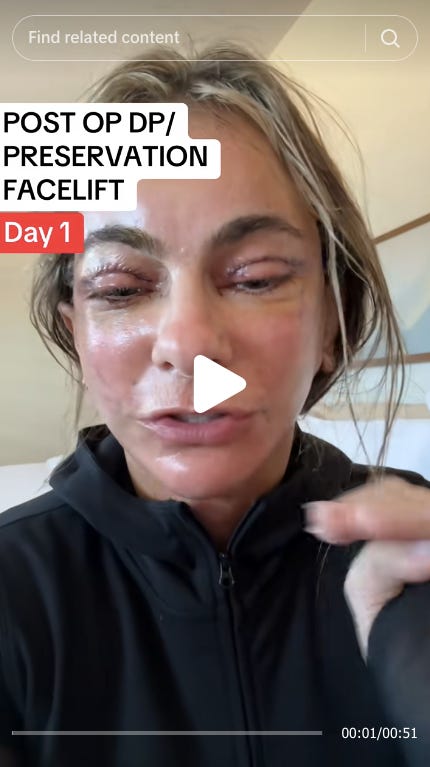
If you read my last post, you know I’m deep in research mode on a deep plane facelift — trying to find that line between “refreshed” and “obviously done.” Since then, I stumbled onto something that’s made this whole decision feel less theoretical: a content creator named Cristina Muise (@cristina.noh) has been documenting her actual recovery, day by day, from a deep plane facelift, neck lift, and upper blepharoplasty — performed by Dr. Roskies in Toronto, one of the very surgeons I’ve been following.
And honestly? It’s been one of the more reassuring things I’ve watched in this whole process.
Watching It Unfold, Not Just the Before/After
Most of what you find on this topic is polished, a dramatic before, a glowing after, and nothing in between. Cristina’s posts are the opposite. She confirmed the surgery was booked, then started posting real-time updates from inside recovery: day 24, day 25, talking through swelling, “zingers” from nerves reawakening, and getting lymphatic drainage massage to help things along. On one of her day-25 updates she noted the swelling had “really turned the corner,” while nerve sensations were still very much part of the picture.

That’s the part that got me. Not the highlight reel — the actual middle. The unglamorous, three-and-a-half-weeks-in, still-a-little-swollen, still-figuring-it-out middle. It’s the part surgeons’ Instagram pages rarely show, and it’s exactly the part I needed to see to feel like this is a real, survivable process and not just a leap of faith.
The Stats Behind What She’s Going Through
Since I’m already knee-deep in research, here’s some curated context on what a deep plane face and neck lift plus upper bleph recovery typically looks like, for anyone following along with her — or considering it themselves:
Deep plane face & neck lift
- Swelling and bruising generally peak around day 2–4, then steadily decline
- Most people feel comfortable in public around the 2–3 week mark; roughly 90% of patients report feeling presentable for work or social settings by week 3
- Numbness and “zinger” nerve sensations (exactly what Cristina described) are common and typically resolve over 3–6 months as sensation returns — sometimes it takes up to a year
- Full, final results continue settling for 6–12 months as deeper tissues fully heal
- Serious complications (hematoma, infection, nerve injury) occur in under 2% of cases with an experienced surgeon
Upper blepharoplasty (eyelid lift)
- Typically the fastest-healing of the three — swelling and bruising around the eyes usually resolve within 1–2 weeks
- Most people feel comfortable going out in public, often with light makeup, by 10–14 days
- Final results usually settle within a few months
Lymphatic drainage massage, which Cristina mentioned using, is something a lot of surgeons recommend starting around 10–14 days post-op — after the deeper surgical planes have had time to heal — to help move residual fluid and speed up the visible de-puffing process.
Why This Actually Matters to Me
I’ve spent months looking at outcome photos of the “best in the business” — Dr. Jacono, Dr. Nayak, Dr. Vasyukevich, Dr. Levine, Dr. Sadati, Dr. Roskies and some surgeons who are less costly but just as experienced — and their results are genuinely beautiful. But results photos don’t tell you what week three feels like. Cristina’s posts do, and it doesn’t hurt that her surgeon, Dr. Roskies, is already on my shortlist. And what they tell me is: it’s a process, it has an ugly middle, and people come out the other side of it looking like themselves, just rested.
That’s the reassurance I didn’t know I needed before making a decision this size. Following someone through the actual timeline — swelling, zingers, lymphatic massage and all — makes the whole thing feel less like a mystery and more like a plan.
More to come as my own research (and hopefully, eventually, my own consultations) continues. Real life in the in-between. Tell me your thoughts on these kinds of procedures and who you would recommend. I want to know.